
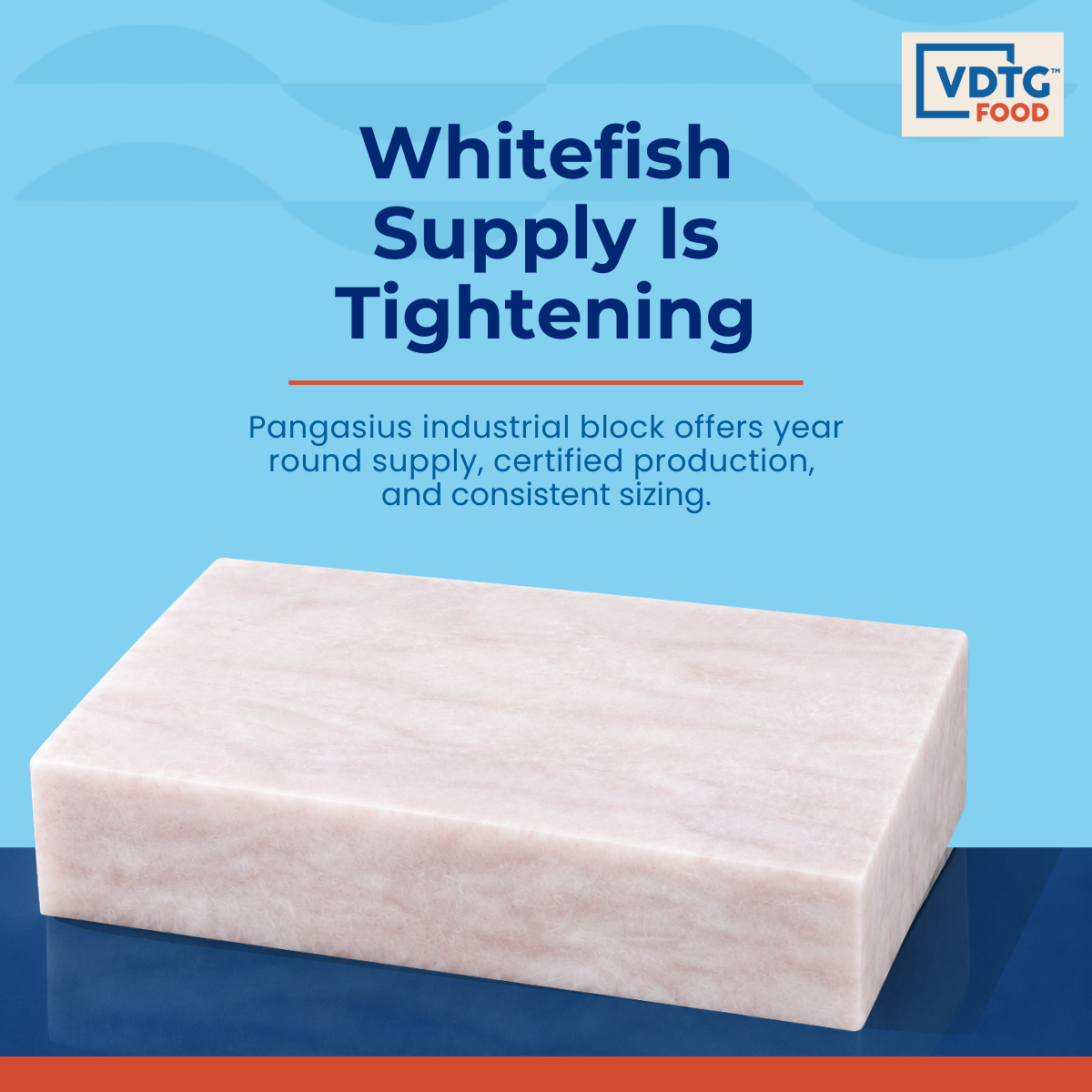
Whitefish Supply Is Tightening: Why Processors Are Looking at Pangasius Industrial Blocks
Whitefish quotas are tightening and supply uncertainty is growing. Discover why seafood processors are turning to pangasius industrial block as a reliable, certified alternative for automated production lines.
The Whitefish Market Is Changing
For seafood buyers, securing whitefish supply has become more complex than negotiating price and volume.
Traditional whitefish markets continue to face supply pressure. The 2026 Arctic/Barents Sea cod quota fell 16% to its lowest levels since 1991, while declining cod and pollock populations have led to further harvest restrictions across major fisheries. At the same time, buyers face growing expectations around traceability, certifications, and supply chain transparency.
As buyers plan H2 programs, the challenge is no longer simply sourcing whitefish. It’s securing reliable supply in a changing market.
1. Supply Security
When supply tightens, availability becomes a competitive advantage.
Before committing to a supplier, buyers should ask:
- How secure is their raw material supply?
- How much control do they have over production?
- Can they maintain volume when demand increases?
- What contingency measures are in place?
Supply disruptions can lead to delayed shipments, inventory shortages, and missed sales opportunities. VDTG Food’s pangasius industrial block addresses this directly. Raised year-round in controlled pond systems, making it a structurally more stable raw material for processors managing consistent production schedules.
2. Traceability and Certifications
As compliance requirements evolve, certifications are becoming a baseline expectation.
Buyers increasingly require food safety assurance, responsible sourcing documentation, and supply chain transparency that supports market access across the US, Europe, and Asia.
For pangasius industrial block, the certification benchmark is clear. ASC covers responsible aquaculture practices. BAP addresses farm-to-processing traceability. BRC covers food safety and manufacturing standards at the facility level. Together, these three certifications address the core compliance requirements that retail and foodservice buyers expect from a block supplier operating at scale.
3. Look Beyond Commodity Fillets: Industrial Block as the Foundation for Value-Added Programs
Securing raw material is only part of the equation. Across Europe and the US, processors are increasingly moving away from commodity fillets toward industrial blocks as the preferred input for breaded and value-added production. The shift is driven by automation investment, margin pressure, and growing retail demand for portion-controlled, ready-to-cook formats.
Pangasius industrial block is well positioned to serve this demand, as the starting point for portion-controlled fillets, fish fingers, fish bites, breaded products, and private label ready-to-cook solutions.
Built for Automated Lines
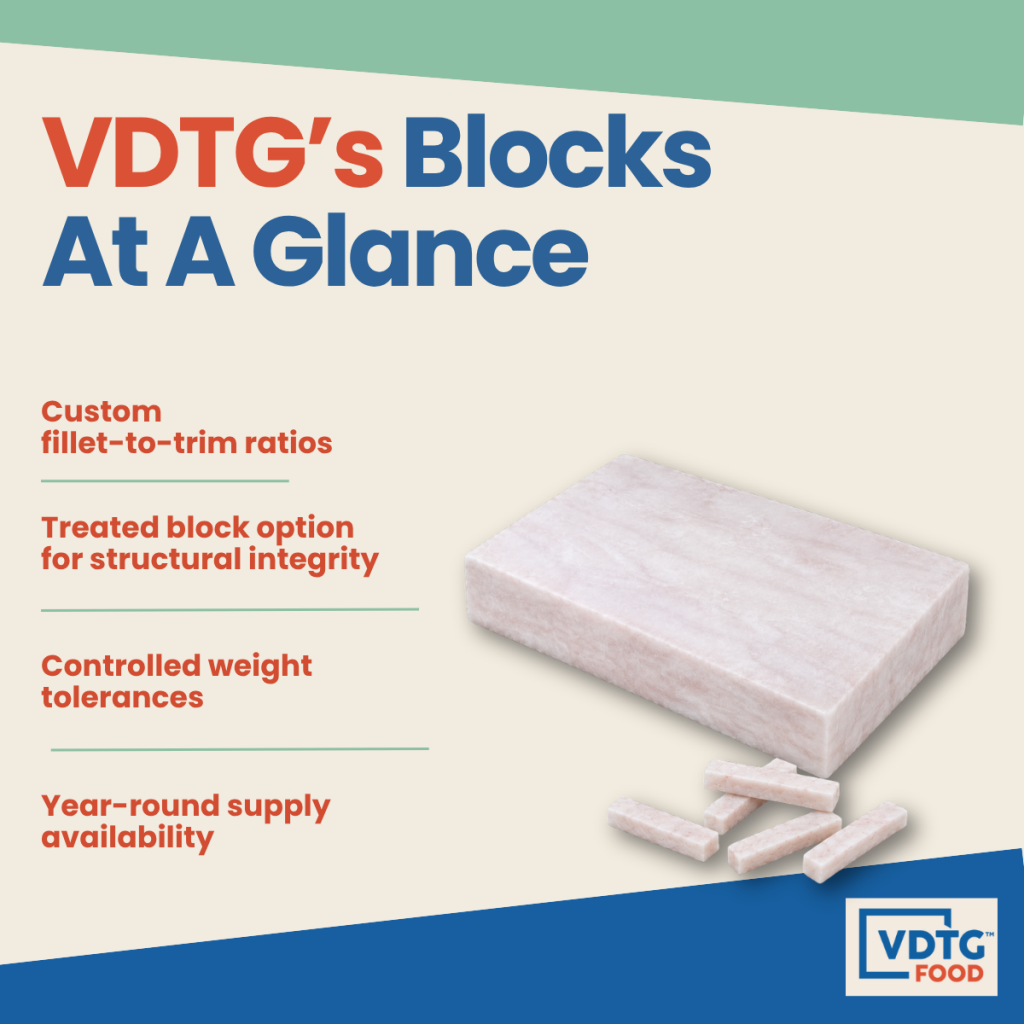
At VDTG Food, pangasius industrial blocks are produced to standardized dimensions of 482 × 254 × 62 mm and can be customized to customer specifications. Our most common 70% whole fillet and 30% trim specification helps minimize voids and air bubbles, supporting block integrity during automated cutting and forming.
From Block to Finished Product
Once portioned, products move directly into a fully automated breaded line running at 1.5 tons per hour, covering:
- Fish fingers
- Fish bites
- Formed Fillet
How VDTG Food Supports These Priorities
> Reliable Supply Starts at the Source
VDTG Food maintains a sustainable supply chain and control across fish farming, and production, helping support supply continuity, quality consistency, and traceability.
> Built Around Compliance
ASC, BAP, and BRC-certified production facilities help customers meet food safety, sourcing, and compliance requirements.
> Processing Performance
Standardized block dimensions, optimized composition, automated forming and breaded production built for high-volume automated lines.
> Designed for Market Needs
Through our private label capabilities, VDTG Food helps partners adapt products to different market requirements, from coatings and flavors to portion sizes, packaging, and value-added formats.
As H2 approaches, the suppliers best positioned to support buyers will be those that combine secure supply, certified production, and the flexibility to adapt as market conditions evolve.
Frequently Asked Questions
- What is pangasius industrial block?
Pangasius industrial block is a standardized frozen raw material produced from pangasius fillets and trim, compressed into a uniform block for use in automated portioning, forming, and breaded seafood production. At VDTG Food, the standard block specification is 482 x 254 x 62 mm, produced with custom fillet-to-trim ratios. - How does pangasius industrial block compare to whitefish for processing?
Our pangasius industrial block is single-frozen helping preserve texture integrity before downstream manufacturing as our raw material arrives at the factory within 24 hours of harvest. Some wild-caught whitefish may undergo twice or thrice frozen depending on harvesting and processing logistics. Combined with standardized dimensions and controlled weight tolerances, VDTG Food’s pangasius industrial block supports consistent performance on automated portioning and forming lines. - What certifications does pangasius industrial block require for US and EU markets?
For US and EU market access, buyers typically require ASC certification for responsible aquaculture, BAP for farm-to-processing traceability, and BRC for food safety and manufacturing standards. VDTG Food’s pangasius industrial block is produced under all three certifications. - What portion sizes and formats can be produced from pangasius industrial block?
Pangasius industrial block can be cut and formed into a range of finished formats including fish fingers, fish bites (16-18g, and more), and formed fillets (70g, 100g, and more). Products can move directly into breaded production after portioning, with VDTG Food’s automated breaded line running at 1.5 tons of finished coated product per hour.
Planning your H2 whitefish program? Talk to our team about certified supply, value-added solutions, and sourcing strategies built for today’s market realities.
👉 Contact us: https://vdtgfood.com/contact/