
Pangasius Market 2026: What the Q1 Data Tells Buyers About Vietnam Seafood Exports
Vietnam’s seafood export sector did not slow down in Q1/2026. According to Vietnam Association of Seafood Exporters and Producers (VASEP), total exports reached 2.64 billion USD in January through March, up 14.4% year-on-year. The growth was not uniform across categories and that divergence is exactly where the buying opportunity sits for Western procurement teams.
This brief unpacks the five data points that matter most for foodservice operators and retail buyers in the EU, US, and UK, with a close focus on pangasius, which continued to outperform expectations.
Section 1: Vietnam’s Seafood Exports Post $2.64B in Q1/2026: Pangasius Leads Certified Growth
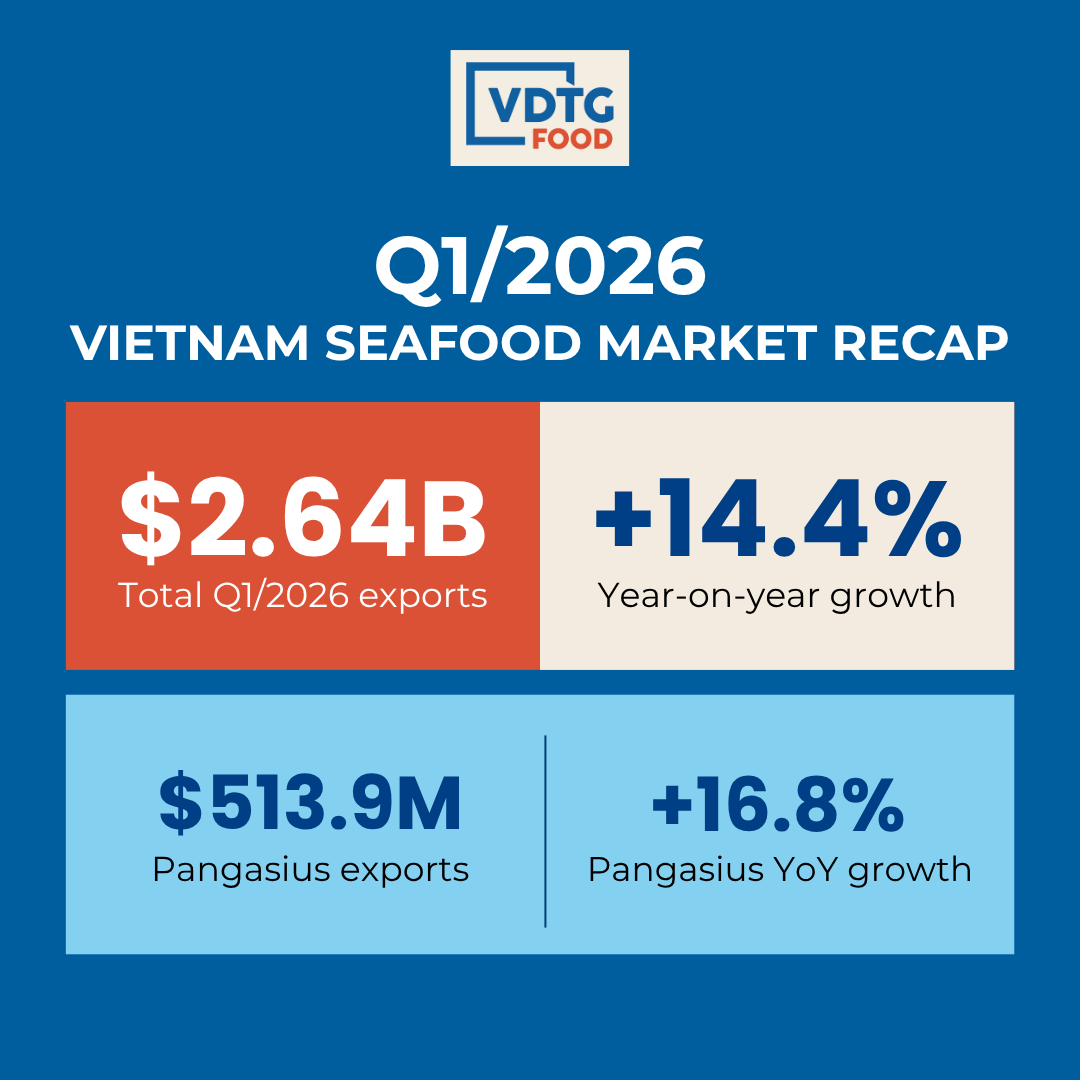
| $2.64B Total Q1/2026 exports | +14.4% Year-on-year growth | $513.9M Pangasius exports | +16.8% Pangasius YoY growth |
In Q1/2026, Vietnam’s total seafood exports reached 2.64 billion USD, up 14.4% year-on-year. Pangasius accounted for 513.9 million USD of that total, up 16.8%, making it the second-largest export category at 19.4% of industry value. Within the pangasius segment, frozen fillets drove the bulk of growth, reaching 422.2 million USD a 19.3% year-on-year increase and representing 82% of all pangasius export value.
Growth across the broader seafood sector was uneven. Shrimp crossed 1 billion USD (+17.5%), driven largely by lobster exports to China rather than processed whiteleg shrimp. Tuna declined 4.4%, reflecting MMPA compliance pressures and weak demand recovery in the US and EU. Pangasius and certified aquaculture products were among the clearest outperformers, a structural pattern that reflects both supply stability and growing buyer preference for traceable, certified protein.
For suppliers operating within this shift, the question is no longer whether certification matters, but how consistently it can be delivered at scale.
VDTG Food operates squarely within this certified aquaculture segment. With BAP, ASC, IFS, and more certifications across our pangasius portfolio, we are positioned to serve the buyers who need documentation as much as they need the protein.
Source: VASEP Q1/2026 Report, Tables 1 and 50
Section 2: The Whitefish Shortage Is Real, And The EU Feels It Most
The EU pangasius market tells a nuanced story in Q1. Overall exports declined 8% to 40 million USD, with Germany down 26% and Italy down 30%. But the headline number obscures something important: the shortage of intra-EU whitefish supply, combined with continued cuts to cod and pollock TAC, is structurally opening the market for alternatives.
The VASEP report puts it directly: supply constraints on wild-caught whitefish are creating opportunities for Vietnamese pangasius, but competition now comes with stricter quality and documentation requirements. This is the right environment for certified suppliers and a challenging one for those without full traceability.
One data point stands out: value-added processed pangasius was the only EU segment showing positive growth in Q1 up 20% to 922 thousand USD. Small in absolute size, but directionally significant. EU buyers are not simply looking for frozen fillet volume anymore. They are prioritising processed and convenient formats that reduce kitchen labour, improve portion consistency, support margin control, and align with increasingly strict sustainability reporting expectations across retail and foodservice channels. For buyers sourcing whitefish for EU retail or foodservice, this creates a timely opportunity. Certified VAP supply is available now, before increasing demand begins tightening supply availability and extending lead times into H2.
Source: VASEP Q1/2026 Report, Tables 57 and 58
Section 3: The US – Volume Down, But the Certified Fillet Opportunity Is Intact
US exports were the one soft spot in the overall pangasius export, 67 million USD, down 3% overall. The context matters: the broader US whitefish import market contracted 46% in the first two months of 2026, as tariff uncertainty and importer inventory caution squeezed order flow across the entire category. Against that decrease, the pangasius frozen fillets category sees positive growth, growing 3% to 65 million USD and accounting for 97% of all US pangasius exports.
The VASEP report identifies the opportunity clearly: as US consumers become more price-sensitive, March data showed frozen shrimp prices rising over 12% while purchase volume fell 17.7% the demand for good-value certified protein grows. Pangasius positioned as a quality alternative to expensive whitefish, not as the cheapest option on the shelf, is where the US opportunity sits in 2026. For US buyers reviewing their frozen whitefish mix for H2, this may be the window to reassess where certified value and supply stability can create a stronger position.
Source: VASEP Q1/2026 Report, Tables 54 and Chapter VI Section III
Section 4: Emerging Markets – Latin America Is Building Real Volume
Two markets worth flagging for buyers tracking where pangasius supply relationships are forming: Mexico reached 22.4 million USD (+42%) and Colombia 15.7 million USD (+71%) in Q1. Japan added 11.2 million USD (+25%). These are not one-off spikes, they reflect a structural diversification of pangasius demand beyond the US, EU, and Brazil, which have long absorbed the bulk of Vietnamese export volume.
For Western buyers, this matters in two ways. First, growing demand across multiple markets simultaneously reduces the price volatility risk that comes from over-concentration. Second, it signals that pangasius is establishing genuine product preference across different consumer markets which is the foundation of long-term supply stability.
Pangasius market performance by key destination, Q1/2026:
| Market | Q1/2025 (USD M) | Q1/2026 (USD M) | YoY |
| China and HK | $93.1M | $152.1M | +63% |
| USA | $69.4M | $67.1M | -3% |
| Brazil | $46.6M | $40.5M | -13% |
| Mexico | $15.8M | $22.4M | +42% |
| Colombia | $9.2M | $15.7M | +71% |
| UK | $12.8M | $15.4M | +21% |
| Japan | $9.0M | $11.2M | +25% |
| EU Total | $43.4M | $40.0M | -8% |
Section 5: The 2026 Forecast – Pangasius Is the Strongest Growth Category
VASEP’s full-year 2026 forecast projects pangasius growth at 8-10% the highest projected growth rate of any major Vietnamese seafood category. Total pangasius exports are expected to reach approximately 2.3 billion USD for the year. The overall Vietnam seafood industry is forecast to reach 11.7-12 billion USD, growing 5-7%.
The growth thesis is structural. Cod supply to the EU is tightening as catch quotas continue to be cut, and farmed cod production cannot fill the gap in the short term. VASEP projects EU pangasius to grow 5-8% for the full year, with the opportunity concentrated in certified suppliers able to meet tightening documentation requirements. In the US, full-year pangasius growth of 3-5% is forecast, with demand focused on processed formats and convenient portions.
The ceiling on pangasius growth in 2026 is not demand. It is the ability to deliver certified volume at consistent quality. That is the supply-side constraint that determines which exporters capture the growth and which watch it from the sidelines.
Source: VASEP Q1/2026 Report, Chapter VI Section IV
What This Means If You Are Sourcing Pangasius in 2026
The Q1/2026 data confirms the direction the market has been building toward for the past 18 months. Whitefish supply from traditional species is constrained and getting more expensive. Buyers in the EU and UK are actively looking for certified, traceable alternatives. The US market is under pressure to replace expensive, tariff-affected whitefish with certified alternatives at a competitive landed cost. And the full-year pangasius forecast is the strongest across the Vietnamese seafood category.
At VDTG Food, we support that shift with certified IQF pangasius fillets and value-added formats including breaded, marinated, and portion-cut products produced from our Mekong Delta facilities. Backed by BAP, ASC, IFS, and Sedex certifications, full traceability documentation, and scalable production capability, we work with retail and foodservice partners to develop reliable whitefish programmes built for today’s pricing, compliance, and operational realities.
If you are planning your H2’26 seafood programme, the market signals are already clear: demand is moving toward certified, cost-efficient whitefish solutions with stable supply behind them.
Ready to plan your Q3 product launch? Get in touch with our team: https://vdtgfood.com/contact/
All data sourced from: VASEP Vietnam Seafood Export Report Q1/2026, based on Vietnam Customs records. Published May 2026. Full report available via vasep.com.vn.
FAQ About the Pangasius Market in 2026
Pangasius demand is increasing due to tightening cod and pollock supply, rising whitefish prices, and growing buyer demand for certified, cost-efficient seafood alternatives.
In Q1/2026, strong growth was recorded in the UK (+21%), Japan (+25%), Mexico (+42%), and Colombia (+71%), according to VASEP data.
Western retail and foodservice buyers increasingly require certifications such as BAP, ASC, IFS, and Sedex to meet traceability, sustainability, and compliance requirements.
Frozen fillets remain the dominant export format, while processed and value-added formats are gaining traction in the EU and US due to labour-saving and convenience trends.